
Policies
Focus and Scope
Journal COMPLETE is a national open scientific journals which seeking innovation, creativity, and novelty. Either letters, research notes, articles, supplemental articles, or review articles in the field of Electrical, Computer, and Telecommunication technology.
Scope of the journal include :
- Technology utilization of maritime resources
- Strengthening infrastructuremaritime
- Operational efficiency
- Electronics technology
- Telecommunication technology
- Computer technology
- System security
- Advanced robotics technology
- Technology and disaster management
- Advanced power electronics
- Application of power system
- Renewable energy
- Chips technology
- Smart iot devices
- 5g technology and ecosystems
- Technology and management environment
Peer Review Process
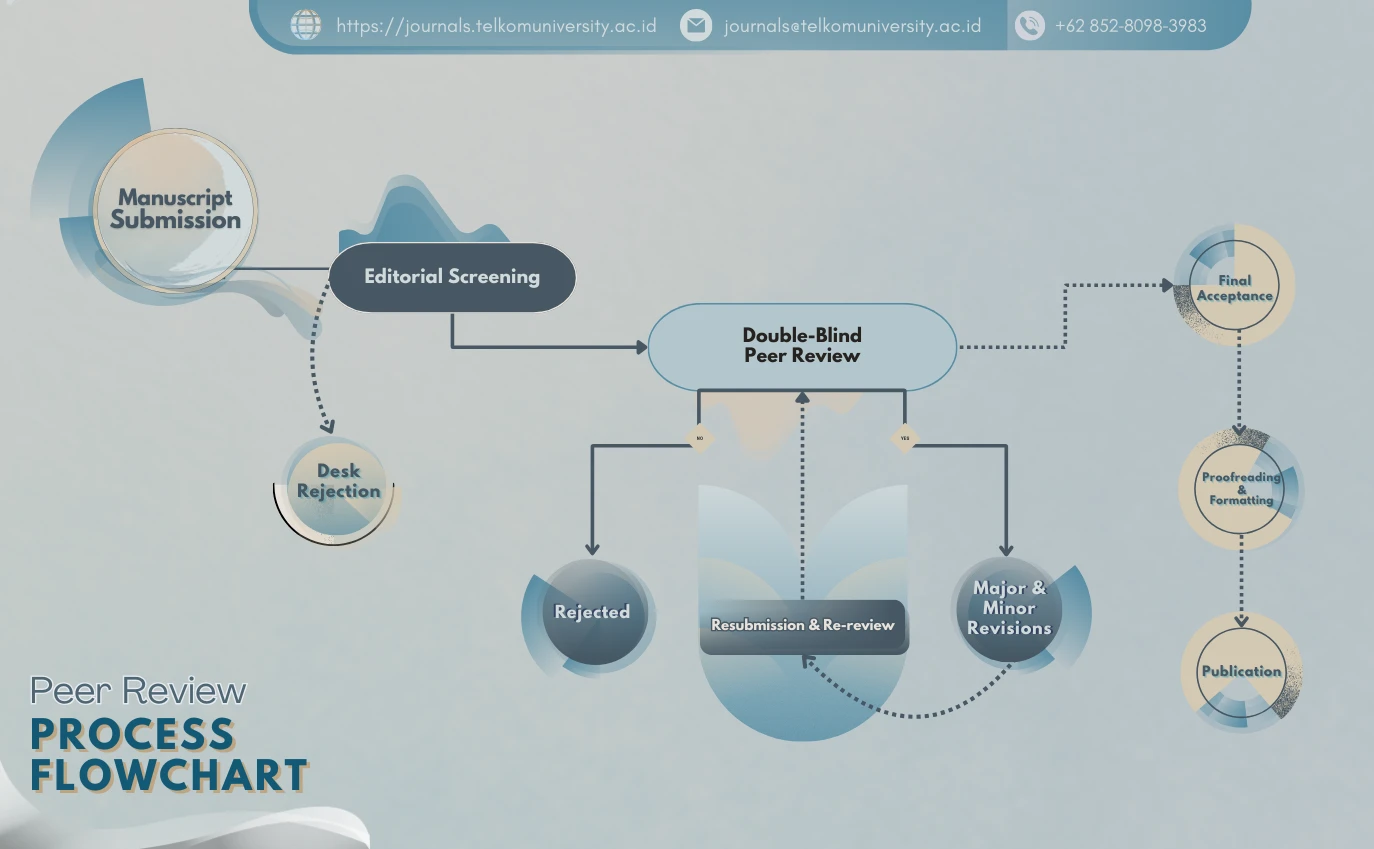
Journal of Computer, Electronic, and Telecommunication follows a double-blind peer review process to ensure the quality, integrity, and originality of published research. Our review process is designed to maintain rigorous academic standards while promoting fairness and transparency.
1. Initial Submission and Editorial Screening
- Submitted manuscripts are first screened by the editorial team to ensure compliance with the journal's focus, scope, formatting requirements, and ethical guidelines.
- Manuscripts that fail to meet the basic criteria may be desk rejected or returned to authors for revision before proceeding to review.
2. Double-Blind Peer Review
- Manuscripts that pass the initial screening are sent to at least two independent reviewers who are experts in the relevant field.
- Both the author(s) and reviewers remain anonymous throughout the process to maintain impartiality.
- Reviewers evaluate the manuscript based on originality, methodological rigor, significance of contributions, clarity of presentation, and adherence to ethical standards.
3. Reviewer Recommendations
Based on the reviewers' feedback, the manuscript may receive one of the following decisions:
- Accepted – Minor or no revisions required.
- Revisions Required – The manuscript requires minor revisions and will be accepted after satisfactory changes.
- Major Revisions – The manuscript needs substantial improvements and must be resubmitted for further review.
- Rejected – The manuscript does not meet the journal's quality or relevance standards.
4. Revision and Final Decision
- Authors are given a timeframe to revise their manuscripts based on reviewer comments.
- Revised manuscripts may be re-evaluated by the original reviewers or the editorial team.
- The Editor-in-Chief makes the final publication decision based on reviewers' recommendations and editorial assessments.
5. Publication
- Accepted articles undergo final proofreading and formatting before publication.
Once ready, articles are published in the latest issue of the journal and made available online with DOI (Digital Object Identifier) for academic referencing.
Ethical Considerations
- The journal strictly follows plagiarism checks using plagiarism detection software.
- Reviewers and editors adhere to the COPE (Committee on Publication Ethics) guidelines to ensure fairness, confidentiality, and ethical research practices.
Open Access Policy
Journal of Computer, Electronic, and Telecommunication is committed to promoting open and free access to knowledge. The journal follows an Open Access model, ensuring that all published articles are freely available to the public without any subscription or paywall.
1. Free and Immediate Access
- All articles published in this journal are immediately and permanently available online upon publication.
- Readers can access, download, and share full-text articles without any financial, legal, or technical barriers.
2. Licensing and Copyright
- The journal applies a Creative Commons Attribution (CC BY) license, allowing users to:
- Share – Copy and redistribute the material in any medium or format.
- Adapt – Remix, transform, and build upon the material for any purpose, even commercially.
- Proper Attribution – Users must give appropriate credit to the original author(s) and provide a link to the license.
- Authors retain full copyright of their work, granting the journal the right to publish and distribute it.
3. Benefits of Open Access
By adopting an Open Access policy, Journal of Computer, Electronic, and Telecommunication ensures:
- Greater visibility and readership for authors and their research.
- Wider dissemination and impact of knowledge in the field of informatics.
- Faster and unrestricted access to cutting-edge research for scholars, practitioners, and the general public.
4. Archiving and Long-Term Preservation
- Published articles are archived in trusted digital repositories to ensure long-term accessibility and preservation.
- The journal follows standard indexing and archiving practices to maintain the integrity of published research.
This Open Access Policy aligns with global efforts to promote the free exchange of academic knowledge, fostering innovation and collaboration in the field of informatics.
Archiving Policy
Journal of Computer, Electronic, and Telecommunication is committed to ensuring the long-term preservation and accessibility of all published content. The journal employs reliable digital archiving solutions to safeguard scholarly work for future use.
1. LOCKSS System for Secure Archiving
- The journal utilizes the LOCKSS (Lots of Copies Keep Stuff Safe) system, which provides a distributed archiving system to ensure digital preservation and redundancy.
- Through LOCKSS, multiple copies of the journal's content are stored across a network of participating libraries, protecting against loss, corruption, or removal.
2. Digital Repositories and Indexing
- All published articles are permanently stored and indexed in reputable academic repositories and databases.
- The journal follows industry-standard preservation practices to maintain the integrity and authenticity of scholarly content.
3. Accessibility and Long-Term Availability
- Archived content remains freely accessible to researchers, institutions, and the public, even in the event of technical failures or unforeseen circumstances.
- The archiving policy aligns with Open Access principles, ensuring that knowledge remains widely available without barriers.
This archiving policy guarantees the security, availability, and preservation of all scholarly publications in this journal.
Author Fees
Free for submissions that include at least one author from outside Indonesia. This includes mixed author groups with both Indonesian and international authors.
A fee of IDR 500,000 applies if all authors of the submission are from Indonesia.
Please note that no payment is required during the submission process. Fees are only charged after the paper is accepted for publication. Submissions remain free of charge until they are formally accepted following the peer-review process.
Publication Ethics and Malpractice Statement
STATEMENT
COMPLETE (p-ISSN: 2723-4371 & e-ISSN: 2723-5912) is a peer-reviewed journal published by Telkom University in Cooperation with Forum Teknik Elektro Indonesia (FORTEI) that committed to upholding the highest standards of publication ethics and takes all possible measures against publication malpractice. This statement clarifies ethical behavior of all parties involved in the act of publishing an article in this journal, including the author, editor, reviewer and publisher. This statement is based on COPE’s Best Practice Guidelines for Journal Editors. Our responsibility is to publish original work of value to the intellectual community in the best possible form and to the highest possible standards. We expect similar standards from our reviewers and authors. Honesty, originality, and fair dealing on the part of authors, and fairness, objectivity, and confidentiality on the part of editors and reviewers are among the critical values that enable us to achieve our goal. COMPLETE is committed to following best practices on ethical matters, errors, and retractions, and to provide a legal review if necessary.
Here are the deal and ethical standards for all parties involved in scientific publications, such as editor, reviewer, and author.
DUTIES OF EDITORS
Editor of the Journal of Complete is responsible for taking decisions manuscripts will be published in the Journal of Complete. The editor can be guided by the policy of the editorial board and constrained by the requirements of applicable laws regarding defamation, copyright infringement and plagiarism. Editors can discuss with other editors or reviewer in making this decision.
Fair Play
Editors will evaluate the manuscripts in accordance with the intellectual content without regard to race, sex, sexual orientation, religion, ethnicity, nationality, or political philosophy of the author
Confidentiality
The Editor and editorial staff should not provide any information about a submitted manuscript to someone other than the corresponding author, reviewers, potential reviewers, other editorial advisers, and the publisher, as appropriate.
Conflict of interest
The materials that are not published in a submitted manuscript may not be used for the editor's own research without the express written consent of the author.
DUTIES OF REVIEWER
Contribution to Editorial Decisions
The review process may assist the auditor in making editorial decisions and through the communication between editor with the author will assist the author in improving the manuscript.
Promptness
Any selected referee who feels unqualified to review the research reported in a manuscript or knows that its prompt review will be impossible should notify the editor and excuse himself from the review process.
Confidentiality
Each manuscript has been accepted for review must be treated as confidential documents. The manuscript should not be shown or discussed with others except with permission from the editor.
Standards of Objectivity
The review should be conducted objectively. Personal criticism of the author is not allowed. Reviewers must show clearly the results of the assessment along with supporting arguments.
Acknowledgement of Sources
Reviewers should identify relevant published work that has not been cited by the authors. Any statement that an observation, derivation, or argument had been previously reported should be accompanied by the relevant citation. A reviewer should also call to the editor's attention any substantial similarity or overlap between the manuscript under consideration and any other published paper of which they have personal knowledge.
Conflict of Interest
Unpublished material contained in the manuscript must not be used for the reviewer's own research without the written permission of the author. Special information and ideas obtained through a review process should be kept confidential and not used for personal purposes. Reviewers should not consider manuscripts that have a conflict of interest due to a script that is competitive, collaborative, or other relationships with one of the authors, or a company involved with the script.
DUTIES OF AUTHOR
Reporting Standard
Authors of reports of original research should present an accurate account of the work performed as well as an objective discussion of its significance. The main data to be represented accurately in the script. The manuscript should contain sufficient detail and references that allow others to do the research again. Fraudulent or knowingly inaccurate statements constitute unethical behavior and are unacceptable.
Data Access and Retention
The author was asked to provide the raw data associated with the text for editorial review process and should be prepared to provide public access to such data , if practicable, and should in any event be prepared to retain such data for a reasonable time after publication.
Originality and Plagiarism
The authors should ensure that they have written entirely original works, and if the authors have used the work and/or words of others that this has been appropriately cited or quoted.
Multiple, Redundant or Concurrent Publication
An author should not, in general, publish manuscripts describing essentially the same research in more than one journal or primary publication. Submitting the same manuscript to more than one journal concurrently constitutes unethical publishing behavior and is unacceptable.
Acknowledgment of Sources
Proper acknowledgment of the work of others must always be given. Authors should cite publications that have been influential in determining the nature of the reported work.
Authorship of the Paper
Authorship should be limited to those who have made a significant contribution to the conception, design, execution, or interpretation of the reported study. All those who have made significant contributions should be listed as co-authors. Where there are others who have participated in certain substantive aspects of the research project, they should be acknowledged or listed as contributors. The corresponding author should ensure that all appropriate co-authors and no inappropriate co-authors are included on the paper, and that all co-authors have seen and approved the final version of the paper and have agreed to its submission for publication.
Disclosure and Conflicts of Interest
All authors should disclose in their manuscript any financial or other substantive conflicts of interest that might be construed to influence the results or interpretation of their manuscript. All sources of financial support for the project should be disclosed.
Fundamental Errors in Published Work
When an author discovers a significant error or inaccuracy in his/her own published work, it is the author's obligation to promptly notify the journal editor or publisher and cooperate with the editor to retract or correct the paper.
Policy of Screening for Plagiarism
Plagiarism screening will be conducted by COMPLETE Editorial Board using iThenticate plagiarism detection tools. COMPLETE will immediately reject any papers that suggests plagiarism or self-plagiarism.
Before submitting articles to reviewers, they are first checked for similarity/plagiarism, by a member of the editorial team. The manuscripts submitted to COMPLETE must have a similarity level of less than 20%.
Plagiarism is the use of another person’s thoughts or words as though they were your own, without permission, credit, or acknowledgment, or due to the failure to cite sources properly. Plagiarism can take diverse forms, from literal copying to paraphrasing the work of another. In order to properly judge whether an author has plagiarized, we emphasize the following possible situations:
- An author can literally copy another author’s work, by copying word by word, in whole or in part, without permission, acknowledging or citing the original source. This practice can be identified through comparing the original source and the manuscript/work who suspected of plagiarism.
- Substantial copying implies for an author to reproduce a substantial part of another author, without permission, acknowledgme,nt or citation. The substantial term can be understood both in terms of quality and quantity, being often used in the context of Intellectual property. Quality refers to the relative value of the copied text in proportion to the work as a whole.
- Paraphrasing involves taking ideas, words, or phrases from a source and crafting them into new sentences within the writing. This practice becomes unethical when the author does not properly cite or does not acknowledge the original work/author. This form of plagiarism is the more difficult form to be identified.
Retraction Policy
Journal of Computer, Electronic, and Telecommunication is committed to maintaining the integrity of the scholarly record. Retractions are issued in accordance with the Committee on Publication Ethics (COPE) guidelines to correct the academic record when significant ethical violations, errors, or misconduct are identified in published articles.
1. Grounds for Retraction
An article may be retracted under the following circumstances:
- Plagiarism: If the article contains significant portions copied from other works without proper citation.
- Data fabrication or falsification: If the research findings are based on manipulated, fabricated, or falsified data.
- Duplicate publication: If the same article has been published in another journal without proper justification or approval.
- Ethical breaches: If the article violates ethical research standards, including human or animal research ethics.
- Undisclosed conflicts of interest: If serious undisclosed conflicts of interest are found that compromise the credibility of the research.
- Major errors affecting validity: If errors in data analysis, methodology, or results significantly alter the study's conclusions.
2. Retraction Process
- The editorial board initiates an investigation upon receiving allegations of misconduct or errors.
- Authors are given an opportunity to respond to concerns before a final decision is made.
- If retraction is justified, the journal will:
- Publish a formal retraction notice, clearly stating the reason for the retraction.
- Mark the article as retracted, while keeping the original version available for transparency.
- Update indexing databases to reflect the retraction.
3. Retraction Notice
A retraction notice will be published in the journal and linked to the original article. It will include:
- The reason for retraction (e.g., plagiarism, ethical violations, or errors).
- A statement clarifying whether the authors agreed to the retraction.
- Information on any related editorial actions.
4. Partial Retractions and Corrections
- If only part of an article is affected by errors, a correction or erratum may be issued instead of a full retraction.
- The correction will be clearly linked to the original article to ensure transparency.
5. Consequences of Retraction
- Retracted articles remain available but are clearly labeled to prevent further citation of unreliable work.
- Authors responsible for misconduct may be banned from future submissions.
- Severe cases of ethical violations may be reported to affiliated institutions or funding agencies.
By enforcing a strict retraction policy, Journal of Computer, Electronic, and Telecommunication upholds the highest standards of research integrity and academic credibility.
Withdrawal Policy
Journal of Computer, Electronic, and Telecommunication is committed to maintaining the integrity of the publication process. Authors are discouraged from withdrawing manuscripts once they have been submitted, as this affects the efficiency of editorial and peer review processes. However, withdrawals may be permitted under specific conditions as outlined below:
1. Withdrawal Before Review Process
- Authors may withdraw their manuscript before it enters the peer review process by submitting a written request to the editorial office.
- The request must be formally submitted by the corresponding author, stating the reason for withdrawal.
2. Withdrawal During or After Peer Review
- Once a manuscript is under review, withdrawal is strongly discouraged.
- If authors wish to withdraw, they must provide a valid reason, and approval is subject to the editorial board's discretion.
- Frequent or unethical withdrawals may result in blacklisting of the author(s) from future submissions.
3. Withdrawal After Acceptance
- Post-acceptance withdrawal is not permitted except in extraordinary circumstances (e.g., ethical concerns, critical errors).
- If the withdrawal request is due to ethical violations or research misconduct, the journal reserves the right to issue a retraction and notify relevant authorities.
4. Unauthorized Withdrawal & Consequences
- If an author withdraws a manuscript unilaterally without notifying the editorial board, they may be barred from submitting future manuscripts for a certain period.
- Institutions or funding agencies may be notified if misconduct is suspected.
5. Editorial Withdrawal Rights
- The journal reserves the right to withdraw a submission if ethical issues, plagiarism, or data falsification are discovered at any stage.
- A retraction notice will be issued for already published articles found to violate academic integrity.
This policy ensures fairness to all contributors and maintains the efficiency and integrity of the publication process.