
Submissions
Submission Guidelines and Requirements
Submission Preparation Checklist
As part of the submission process, authors are required to check off their submission's compliance with all of the following items, and submissions may be returned to authors that do not adhere to these guidelines.- The submission has not been previously published, nor is it before another journal for consideration (or an explanation has been provided in Comments to the Editor).
- The submission file is in OpenOffice, Microsoft Word, or RTF document file format.
- Where available, URLs for the references have been provided.
- The text is single-spaced; uses a 12-point font; employs italics, rather than underlining (except with URL addresses); and all illustrations, figures, and tables are placed within the text at the appropriate points, rather than at the end.
- The text adheres to the stylistic and bibliographic requirements outlined in the Author Guidelines.
Author Guidelines
Submitting Manuscript Procedure
- Authors must register first via the following link: Click here to register.
- After logging in with your author account, follow these steps to submit your article:
- Click "New Submission" on the dashboard.
- In the "Start" section, complete all required checklist fields, then click "Save and Continue".
- In the "Upload Submission" section, upload your manuscript in DOC or MS Word format. Supporting files can also be uploaded in this section (optional). Click "Save and Continue".
- In the "Enter Metadata" section, enter all author data and their affiliations. For multiple authors, click "Add Contributor" and repeat the process. Provide the article title, abstract, keywords, and references in the designated fields.
- Review all entered data for accuracy. In the "Confirmation" section, click Finish Submission to complete the process.
General Instructions
General guidelines for writing in Journal of INISTA are as follows:
- Articles must be written in a format that matches the writing format in Scientific Journals.
- Articles must be original work, never previously published in any print or online journal.
- Articles are written using the article template in the INISTA Journal.
- Articles are written in good and correct English.
- The submitted paper is at least 10 pages and no more than 15 pages. If the number of pages is more than 15 will incur extra charges.
- Make sure that your paper is prepared using the Manuscript Template and Copyright Transfer Form when if it accepted.
- At least 15 references with 80% coming from the original research article (Journal) within 5 years earlier.
Submission General Process
The journal editor or section editor will handle every submission and should follow the process as shown below.
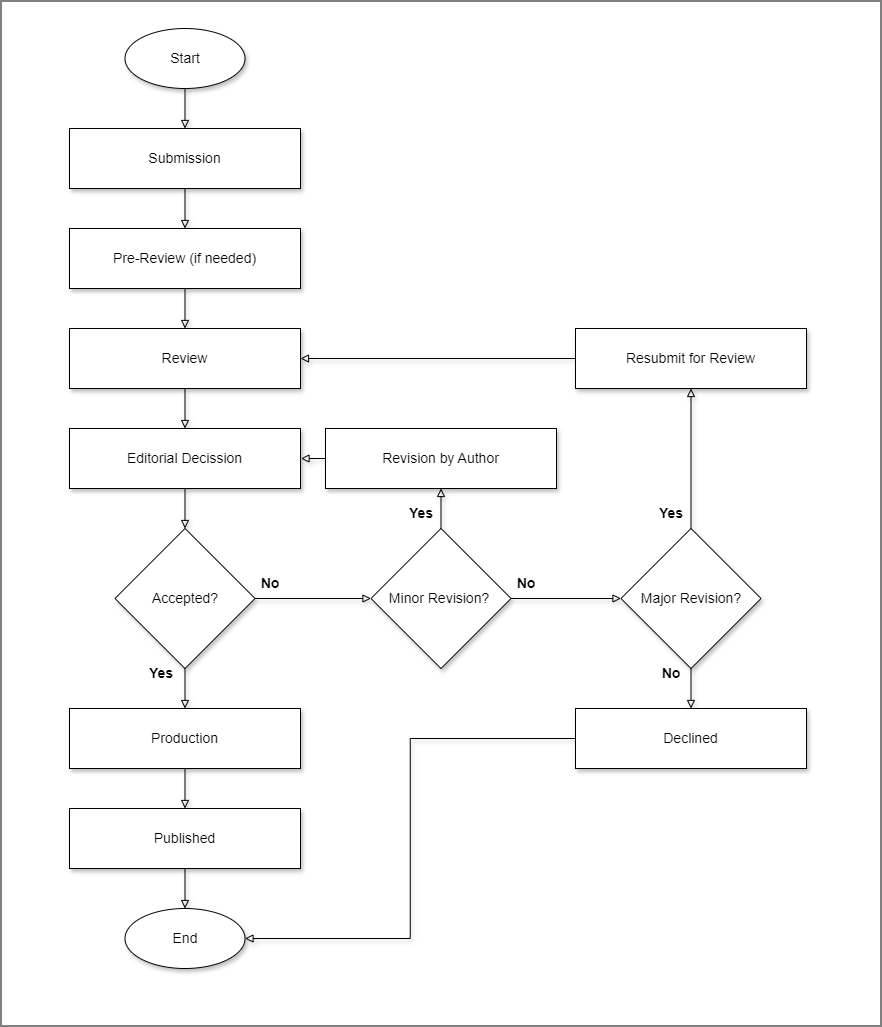
The publication process begins with the submission of a manuscript. If required, a pre-review check ensures the submission meets basic criteria before proceeding to the formal review stage. During the review, the manuscript is evaluated by reviewers, after which the editor makes an editorial decision. If the manuscript is accepted, it moves to production and is eventually published. If minor revisions are requested, the author revises the manuscript, and it may undergo further review. For major revisions, the author makes substantial changes before resubmitting for another round of review. If the manuscript is declined at any point, the process ends. The workflow continues until the manuscript is either published or rejected, ensuring thorough evaluation and opportunities for improvement.
Guidelines for The Manuscript Body Text
Scientific articles published in the Journal of INISTA must follow the writing rules on the paper body. The rules follow the pattern of IMRAD (Introduction, Method, Result, and Discussion); added the last section is the conclusion section.
- Title: The title should be concise and indicate the identity of the subject, the research objectives, and the keywords.
- Author name: The author's name without academic degrees and not preceded by the word "by" followed by the name of the institution, address of institution and contact email.
- Abstract: Abstract should describe the entire content of the article with maximum of 250 word. It is not allowed references to figures and tables. it is written in a straightforward, concise, and must include:
- Background (optional, one or two sentence)
- Research objective
- Method
- Result
- Conclusion
- Keyword: Use keywords that can describe the content of the article. It is written in 3 to 5 words.
- Introduction: Basically, in the introduction provides general background research, literature review (state of the art), originality of research (gap analysis), and research objectives. In the literature review, at least five articles are reviewed briefly that can justify the novelty of the research.
- Method: In the methods section provides a summary of the methods used, such as the subjects studied, tools and materials used, model or design used, sampling technique, the measured variable, analysis and statistical models used.
- Result: In the results section contains the presentation of the results of the research can be illustrated using tables or figures to clarify the presentation of the results verbally. The data presented is data that is processed, not raw data.
- Discussion: material discussion mainly concerned, whether the results are consistent with the hypothesis or not, and put forward the argument.
- Conclusion: write the conclusions of the research that has been done and future works. The conclusion must answer the purpose of the study or hypothesis. Write the conclusion briefly and clearly. Do not discuss again at the conclusion. Do not use Bullet/Numbering.
Guidelines for Citations and References
Style referral source citations in Journal of INISTA Paper using IEEE style. It is advisable to use reference management software such as Mendeley, EndNote, Zotero and others.
Copyright Notice
The copyright to this article is transferred to Universitas Telkom Purwokerto if and when the article is accepted for publication. The undersigned hereby transfers any and all rights in and to the paper, including, without limitation, all copyrights, to Universitas Telkom Purwokerto. The undersigned represents and warrants that the paper is original and that he/she is the author of the paper, except for material that is clearly identified with its original source, along with permission notices from the copyright owners where required. The undersigned further represents that he/she has the power and authority to make and execute this assignment.
We declare that:
- This paper has not been published in the same form elsewhere.
- It will not be submitted elsewhere for publication prior to acceptance or rejection by this journal.
- Copyright permission has been obtained for any materials published elsewhere that require such permission for reproduction.
Furthermore, I/we hereby transfer the unlimited publication rights of the above-mentioned paper in its entirety to Universitas Telkom Purwokerto. The copyright transfer covers the exclusive right to reproduce and distribute the article, including reprints, translations, photographic reproductions, microform, electronic form (offline or online), or any other reproductions of a similar nature.
The corresponding author signs for and accepts responsibility for releasing this material on behalf of all co-authors. This agreement must be signed by at least one author who has obtained the assent of the co-author(s) where applicable. After submission of this agreement signed by the corresponding author, changes to authorship or the order of authors listed will not be accepted.
Retained Rights/Terms and Conditions
- Authors retain all proprietary rights in any process, procedure, or article of manufacture described in the work.
- Authors may reproduce or authorize others to reproduce the work or derivative works for personal or company use, provided that:
- The source and Universitas Telkom Purwokerto copyright notice are indicated.
- The copies are not used in a way that implies Universitas Telkom Purwokerto's endorsement of any product or service.
- The copies themselves are not offered for sale.
- While authors may reuse all or portions of the work in other works, this does not include granting third-party requests for reprinting, republishing, or other forms of reuse.