
Policies
Focus and Scope
TRINISTIK JOURNAL is a scientific forum for the dissemination of research findings, intellectual discourse, and critical analyses in the fields of industrial engineering, digital business, and logistics engineering. It aims to promote excellence in education, research, and community service, and to serve as a valuable reference for scholars and practitioners.
TRINISTIK JOURNAL invites the submission of scholarly articles within the following research domains:
Industrial Engineering
- Ergonomic, Work Study And Safety
- Operational Research
- Manufacturing Facility Design
- Quality Management
- Operations Engineering and Management
- Product Design And Development
Logistic Engineering
- Supply Chain Management
- Logistics Engineering
Digital Business
- Digital Business Strategy, Model And Platform, Service Design
- Technology, Innovation And Digital Transformation.
- Financial Technology
Peer Review Process
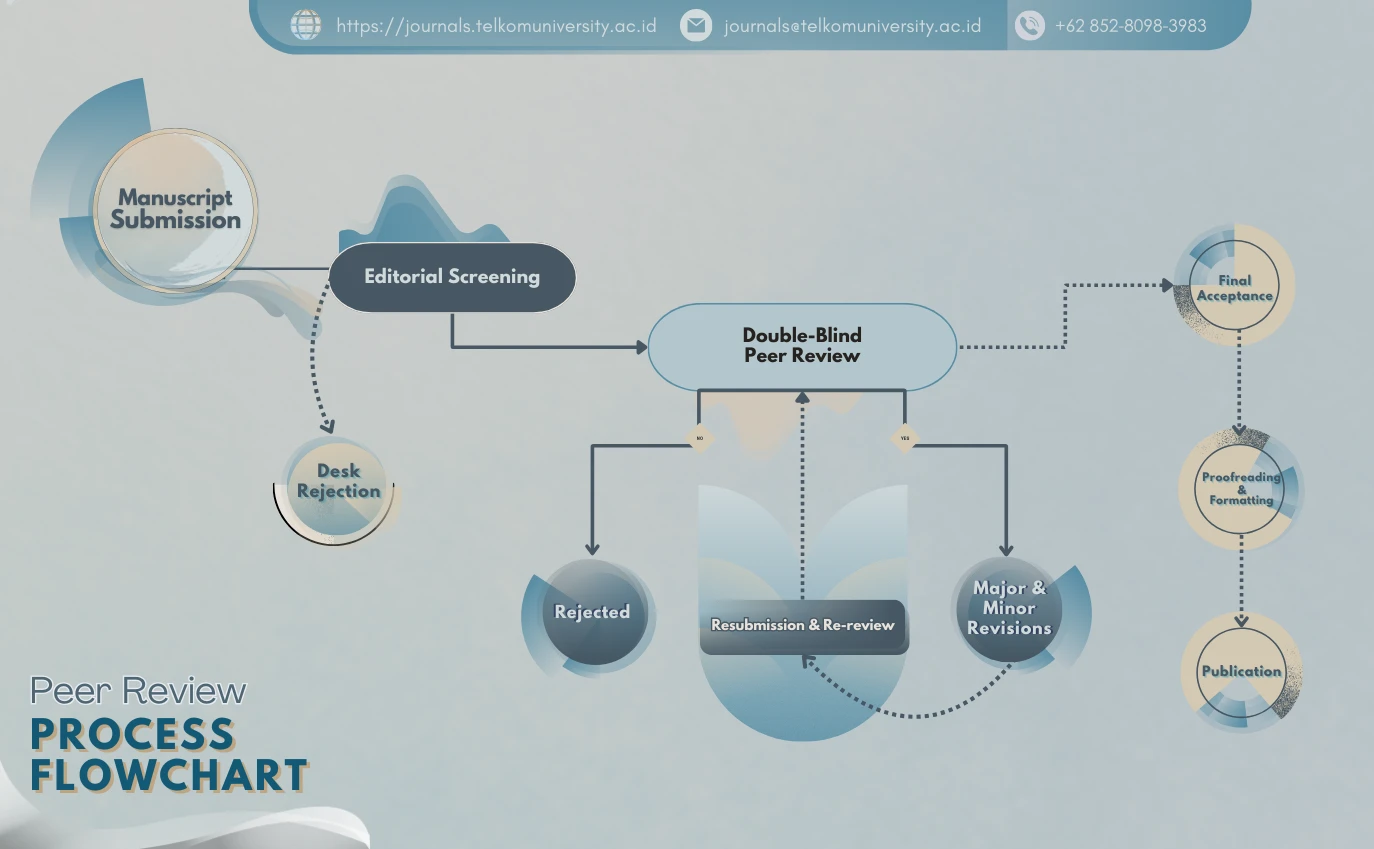
Jurnal Teknik Industri, Bisnis Digital, Dan Teknik Logistik (Jurnal Trinistik) follows a double-blind peer review process to ensure the quality, integrity, and originality of published research. Our review process is designed to maintain rigorous academic standards while promoting fairness and transparency.
1. Initial Submission and Editorial Screening
- Submitted manuscripts are first screened by the editorial team to ensure compliance with the journal's focus, scope, formatting requirements, and ethical guidelines.
- Manuscripts that fail to meet the basic criteria may be desk rejected or returned to authors for revision before proceeding to review.
2. Double-Blind Peer Review
- Manuscripts that pass the initial screening are sent to at least two independent reviewers who are experts in the relevant field.
- Both the author(s) and reviewers remain anonymous throughout the process to maintain impartiality.
- Reviewers evaluate the manuscript based on originality, methodological rigor, significance of contributions, clarity of presentation, and adherence to ethical standards.
3. Reviewer Recommendations
Based on the reviewers' feedback, the manuscript may receive one of the following decisions:
- Accepted – Minor or no revisions required.
- Revisions Required – The manuscript requires minor revisions and will be accepted after satisfactory changes.
- Major Revisions – The manuscript needs substantial improvements and must be resubmitted for further review.
- Rejected – The manuscript does not meet the journal's quality or relevance standards.
4. Revision and Final Decision
- Authors are given a timeframe to revise their manuscripts based on reviewer comments.
- Revised manuscripts may be re-evaluated by the original reviewers or the editorial team.
- The Editor-in-Chief makes the final publication decision based on reviewers' recommendations and editorial assessments.
5. Publication
- Accepted articles undergo final proofreading and formatting before publication.
Once ready, articles are published in the latest issue of the journal and made available online with DOI (Digital Object Identifier) for academic referencing.
Ethical Considerations
- The journal strictly follows plagiarism checks using plagiarism detection software.
- Reviewers and editors adhere to the COPE (Committee on Publication Ethics) guidelines to ensure fairness, confidentiality, and ethical research practices.
Open Access Policy
Jurnal Teknik Industri, Bisnis Digital, Dan Teknik Logistik (Jurnal Trinistik) is committed to promoting open and free access to knowledge. The journal follows an Open Access model, ensuring that all published articles are freely available to the public without any subscription or paywall.
1. Free and Immediate Access
- All articles published in this journal are immediately and permanently available online upon publication.
- Readers can access, download, and share full-text articles without any financial, legal, or technical barriers.
2. Licensing and Copyright
- The journal applies a Creative Commons Attribution (CC BY) license, allowing users to:
- Share – Copy and redistribute the material in any medium or format.
- Adapt – Remix, transform, and build upon the material for any purpose, even commercially.
- Proper Attribution – Users must give appropriate credit to the original author(s) and provide a link to the license.
- Authors retain full copyright of their work, granting the journal the right to publish and distribute it.
3. Benefits of Open Access
By adopting an Open Access policy, Jurnal Teknik Industri, Bisnis Digital, Dan Teknik Logistik (Jurnal Trinistik) ensures:
- Greater visibility and readership for authors and their research.
- Wider dissemination and impact of knowledge in the field of informatics.
- Faster and unrestricted access to cutting-edge research for scholars, practitioners, and the general public.
4. Archiving and Long-Term Preservation
- Published articles are archived in trusted digital repositories to ensure long-term accessibility and preservation.
- The journal follows standard indexing and archiving practices to maintain the integrity of published research.
This Open Access Policy aligns with global efforts to promote the free exchange of academic knowledge, fostering innovation and collaboration in the field of informatics.
Archiving Policy
Jurnal Teknik Industri, Bisnis Digital, Dan Teknik Logistik (Jurnal Trinistik) is committed to ensuring the long-term preservation and accessibility of all published content. The journal employs reliable digital archiving solutions to safeguard scholarly work for future use.
1. LOCKSS System for Secure Archiving
- The journal utilizes the LOCKSS (Lots of Copies Keep Stuff Safe) system, which provides a distributed archiving system to ensure digital preservation and redundancy.
- Through LOCKSS, multiple copies of the journal's content are stored across a network of participating libraries, protecting against loss, corruption, or removal.
2. Digital Repositories and Indexing
- All published articles are permanently stored and indexed in reputable academic repositories and databases.
- The journal follows industry-standard preservation practices to maintain the integrity and authenticity of scholarly content.
3. Accessibility and Long-Term Availability
- Archived content remains freely accessible to researchers, institutions, and the public, even in the event of technical failures or unforeseen circumstances.
- The archiving policy aligns with Open Access principles, ensuring that knowledge remains widely available without barriers.
This archiving policy guarantees the security, availability, and preservation of all scholarly publications in this journal.
Author Fees
Author Fee Information
Submission Fee: Rp0 (Free). Authors are not charged a fee when submitting a manuscript.
Publication Fee (APC): Rp750,000 (or the equivalent of 60 USD).
This processing fee is charged only if the article is accepted for publication. The fee is used to support the journal’s operational management, the editing process, and the maintenance of open access.
Fee Waivers:
The editor may consider requests for fee waivers or reductions based on valid reasons (such as financial constraints or manuscript length). Requests must be submitted in the “Comments for the Editor” field during initial manuscript submission. Requests for fee waivers submitted after this stage will most likely not be processed and will not influence the review decision.
Publication Ethics and Malpractice Statement
TRINISTIK Journal is a scientific journal published by the Institute for Research and Community Service (LPPM). This statement of publication ethics represents the code of ethics for all parties involved in the process of publishing scientific articles in this journal, including the journal managers, editors, peer reviewers, and authors. This Code of Ethics for Scientific Publication upholds three core values of ethics in publication:
- Neutrality — the publication must be managed free from conflicts of interest,
- Fairness — authors must be given the right to have their work evaluated and published based on merit,
- Integrity — all published content must be free from duplication, fabrication, and plagiarism.
The publication ethics of TRINISTIK Journal refers to Regulation No. 5 of 2014 by the Indonesian Institute of Sciences (LIPI) concerning the Code of Ethics for Scientific Publications.
- Duties and Responsibilities of the Journal Manager
- Define the journal's name, scope, publication frequency, and accreditation requirements if necessary.
- Appoint members of the editorial board.
- Establish contractual relationships between publishers, editors, peer reviewers, and other parties.
- Respect confidentiality involving contributors, authors, editors, and reviewers.
- Uphold norms and regulations related to intellectual property rights, particularly copyright.
- Review and communicate journal policies to authors, editors, reviewers, and readers.
- Provide a code of conduct guideline for editors and reviewers.
- Ensure regular publication of the journal.
- Secure financial support for the sustainability of journal publishing.
- Build partnerships and networks for marketing.
- Manage licensing and legal matters.
Duties and Responsibilities of Editors
- Align the needs of readers and authors.
- Strive to improve the quality of the publication continuously.
- Ensure the quality control of published works through a robust editorial process.
- Promote objectivity and academic freedom of expression.
- Safeguard the academic record and author reputation.
- Issue corrections, clarifications, retractions, or apologies when needed.
- Oversee the writing style and formatting, while content and all statements remain the authors' responsibility.
- Actively seek feedback from authors, readers, reviewers, and editorial board members for quality enhancement.
- Encourage journal assessments based on findings or reports.
- Support efforts to reduce research and publication misconduct by requesting authors to submit an approved Ethical Clearance form from the Ethics Committee.
- Promote publication ethics education for researchers.
- Assess the impact of editorial policies on author and reviewer behavior and make improvements as needed.
- Maintain an open mind to new perspectives or ideas that may challenge personal opinions.
- Avoid imposing personal views, those of authors, or third parties that could compromise objectivity.
- Encourage authors to revise their manuscripts to meet publication standards.
Duties and Responsibilities of Peer Reviewers
- Review manuscripts as assigned by editors and provide feedback to support editorial decisions regarding publication eligibility.
- Conduct reviews in a timely manner and in accordance with the journal's format and scientific standards (e.g., research methodology, authorship validity, conclusions).
- Reassess revised manuscripts to ensure compliance with quality standards.
- Motivate authors to improve their manuscripts through constructive criticism, suggestions, input, and recommendations.
- Maintain confidentiality by not disclosing comments, suggestions, or recommendations.
- Avoid reviewing manuscripts where a conflict of interest is present, either directly or indirectly.
- Duties and Responsibilities of Authors
- Ensure all individuals listed as authors meet the authorship criteria.
- Take collective responsibility for the content of the article, including research methods, analysis, calculations, and details.
- Disclose the sources of research funding or support, whether direct or indirect.
- Clearly state any limitations of the research.
- Respond professionally and timely to feedback from reviewers.
- Inform the editor if they wish to withdraw their manuscript.
- Declare that the submitted manuscript is original, has not been previously published in any language, and is not under consideration elsewhere.
Policy of Screening for Plagiarism
To uphold academic integrity and ensure the originality of published research, Jurnal Teknik Industri, Bisnis Digital, Dan Teknik Logistik (Jurnal Trinistik) strictly enforces a plagiarism screening policy. All submitted manuscripts undergo plagiarism detection using iThenticate before being considered for peer review and publication.
1. Plagiarism Detection Process
- All manuscripts are screened using iThenticate plagiarism detection software to check for textual similarity and potential plagiarism.
- The maximum acceptable similarity score is 25%, excluding references/bibliographies.
- Manuscripts exceeding this threshold may be immediately rejected or returned for revision.
2. Definition of Plagiarism
Plagiarism in any form is strictly prohibited. This includes but is not limited to:
- Direct plagiarism: Copying text from another source without citation.
- Self-plagiarism: Reusing portions of an author's own previously published work without proper attribution.
- Mosaic plagiarism: Paraphrasing sentences while maintaining the original structure without proper citation.
- Improper citation: Failing to properly acknowledge sources of ideas, data, or text.
3. Actions for Plagiarism Violations
If plagiarism is detected:
- Minor cases (similarity between 25-30%): Authors will be required to revise the manuscript and provide proper citations.
- Moderate cases (similarity above 30%): The manuscript will be rejected, and authors may be advised to rewrite and resubmit.
- Severe cases (extensive plagiarism, including verbatim copying from multiple sources): Immediate rejection and blacklisting of the author(s) for future submissions.
- If plagiarism is detected after publication, the article may be retracted, and a retraction notice will be issued.
4. Author Responsibility
- Authors must ensure that their submission is original and properly cited.
- If using previously published work (e.g., conference papers), authors must provide transparency regarding self-citation and prior dissemination.
By implementing this plagiarism screening policy, Jurnal Teknik Industri, Bisnis Digital, Dan Teknik Logistik (Jurnal Trinistik) ensures that all published research maintains academic integrity, originality, and scholarly credibility.
Retraction Policy
Jurnal Teknik Industri, Bisnis Digital, Dan Teknik Logistik (Jurnal Trinistik) is committed to maintaining the integrity of the scholarly record. Retractions are issued in accordance with the Committee on Publication Ethics (COPE) guidelines to correct the academic record when significant ethical violations, errors, or misconduct are identified in published articles.
1. Grounds for Retraction
An article may be retracted under the following circumstances:
- Plagiarism: If the article contains significant portions copied from other works without proper citation.
- Data fabrication or falsification: If the research findings are based on manipulated, fabricated, or falsified data.
- Duplicate publication: If the same article has been published in another journal without proper justification or approval.
- Ethical breaches: If the article violates ethical research standards, including human or animal research ethics.
- Undisclosed conflicts of interest: If serious undisclosed conflicts of interest are found that compromise the credibility of the research.
- Major errors affecting validity: If errors in data analysis, methodology, or results significantly alter the study's conclusions.
2. Retraction Process
- The editorial board initiates an investigation upon receiving allegations of misconduct or errors.
- Authors are given an opportunity to respond to concerns before a final decision is made.
- If retraction is justified, the journal will:
- Publish a formal retraction notice, clearly stating the reason for the retraction.
- Mark the article as retracted, while keeping the original version available for transparency.
- Update indexing databases to reflect the retraction.
3. Retraction Notice
A retraction notice will be published in the journal and linked to the original article. It will include:
- The reason for retraction (e.g., plagiarism, ethical violations, or errors).
- A statement clarifying whether the authors agreed to the retraction.
- Information on any related editorial actions.
4. Partial Retractions and Corrections
- If only part of an article is affected by errors, a correction or erratum may be issued instead of a full retraction.
- The correction will be clearly linked to the original article to ensure transparency.
5. Consequences of Retraction
- Retracted articles remain available but are clearly labeled to prevent further citation of unreliable work.
- Authors responsible for misconduct may be banned from future submissions.
- Severe cases of ethical violations may be reported to affiliated institutions or funding agencies.
By enforcing a strict retraction policy, Jurnal Teknik Industri, Bisnis Digital, Dan Teknik Logistik (Jurnal Trinistik) upholds the highest standards of research integrity and academic credibility.
Withdrawal Policy
Jurnal Teknik Industri, Bisnis Digital, Dan Teknik Logistik (Jurnal Trinistik) is committed to maintaining the integrity of the publication process. Authors are discouraged from withdrawing manuscripts once they have been submitted, as this affects the efficiency of editorial and peer review processes. However, withdrawals may be permitted under specific conditions as outlined below:
1. Withdrawal Before Review Process
- Authors may withdraw their manuscript before it enters the peer review process by submitting a written request to the editorial office.
- The request must be formally submitted by the corresponding author, stating the reason for withdrawal.
2. Withdrawal During or After Peer Review
- Once a manuscript is under review, withdrawal is strongly discouraged.
- If authors wish to withdraw, they must provide a valid reason, and approval is subject to the editorial board's discretion.
- Frequent or unethical withdrawals may result in blacklisting of the author(s) from future submissions.
3. Withdrawal After Acceptance
- Post-acceptance withdrawal is not permitted except in extraordinary circumstances (e.g., ethical concerns, critical errors).
- If the withdrawal request is due to ethical violations or research misconduct, the journal reserves the right to issue a retraction and notify relevant authorities.
4. Unauthorized Withdrawal & Consequences
- If an author withdraws a manuscript unilaterally without notifying the editorial board, they may be barred from submitting future manuscripts for a certain period.
- Institutions or funding agencies may be notified if misconduct is suspected.
5. Editorial Withdrawal Rights
- The journal reserves the right to withdraw a submission if ethical issues, plagiarism, or data falsification are discovered at any stage.
- A retraction notice will be issued for already published articles found to violate academic integrity.
This policy ensures fairness to all contributors and maintains the efficiency and integrity of the publication process.